To ensure our website works as well as possible for you

This website uses cookies. Essential cookies keep the website running and are always active. We only use other cookies with your consent for your convenience, statistics, and measurement. You can change your selection at any time in the Detailed cookie settings. For more information, see Terms and conditions for use of website.

Functional cookies These cookies are necessary for the proper functioning of the website and therefore cannot be turned off.
Analytics cookies Analytical cookies help us understand how visitors use our website. They allow us to track and analyze user interactions using tools such as Google Analytics 4 and Microsoft Clarity so that we can improve the content, functionality, and overall user experience. The data collected is processed in aggregate form and is not used for targeted advertising.
Marketing cookies Reading and writing cookies for marketing purposes for advertising systems such as Google Ads or Sklik. These cookies allow us to track user behavior and measure website performance and the effectiveness of our advertising campaigns.
Personalized advertising Remarketing cookies allow us to present you with personalized advertising based on your previous interactions with our site in systems such as Google Ads, Sklik.
Use of personal data With this option, you consent to the sending and processing of your personal data to Google for the purposes of targeting and evaluating online advertising and targeted marketing.
Summer Opening Hours – Paediatrics: 29 June – 28 August 2026: 8am – 4:30pm Outpatient Clinic: Normal, except on: 8 July & 5 August 2026: 8am – 5:30pm
icn
Logo MY CLINIC

Routine Vision Screening Not Enough for Children? 07.03.2026

The Opportunity to Treat Amblyopia Is Limited and Largely Ends by Around the Age of Six

Starting primary school is a major milestone in every child's life. A new environment, learning to read and write, and increased visual demands all place greater strain on a child's developing visual system. To make this important transition with confidence, children need to be able to rely fully on their eyesight. Yet many childhood eye conditions remain undetected for years.

Why Don't Children Say They Cannot See Properly?

A child's brain is remarkably adaptable. If a child has experienced blurred vision from an early age, they simply do not realise that their vision is different because they have nothing to compare it with. Rather than complaining about poor eyesight, the brain and eyes unconsciously compensate for the problem.

This constant effort to focus can be exhausting. If your child:

  • is frequently tired or struggles to concentrate;
  • rubs their eyes regularly; or
  • complains of headaches,

these symptoms may not simply be due to tiredness or inattention but could indicate an undiagnosed vision problem.

Amblyopia: A Race Against Time

When it comes to amblyopia, commonly known as lazy eye, timing is crucial. Once visual development is complete, the condition can no longer be effectively treated.

Amblyopia is not primarily a problem with the eye itself but with the way the brain processes visual information. If one eye consistently provides a blurred image, the brain gradually begins to ignore it. Unless this connection is corrected while the visual system is still developing—ideally before around six years of age—the brain permanently loses the ability to use that eye effectively. Neither glasses nor laser vision correction can reverse this in adulthood.


"With amblyopia, early diagnosis is critical. If we identify the condition during the preschool years, we have an excellent opportunity to improve vision significantly. Studies show that treatment is successful in approximately 77% of children aged between three and seven years. However, success rates decline with age, falling to around 56% in children aged eight to twelve. This is why we encourage parents to arrange a comprehensive eye examination before their child starts school," says Professor Petra Svozílková, MD, PhD, MY CLINIC.

How Is an Examination at MY CLINIC Different from a Routine Vision Screening?

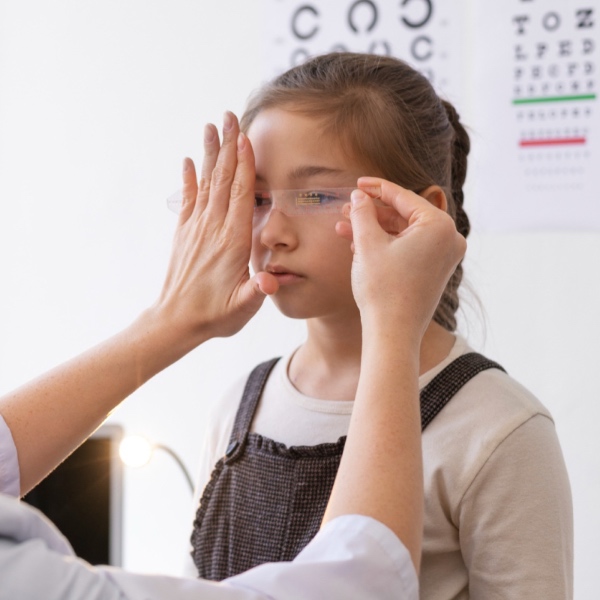
Many parents rely on quick vision screenings carried out in nurseries, schools or by their GP or paediatrician. While these are valuable as an initial screening tool, they cannot replace a comprehensive examination performed by an ophthalmology specialist.


At MY CLINIC, we use advanced diagnostic techniques that provide a much more detailed assessment.

Examination method Why is it important?
Cycloplegic refraction Special eye drops temporarily relax the focusing muscles of the eye. This allows us to measure the child’s true prescription, which the developing eye can otherwise compensate for and mask.
Targeted amblyopia prevention We identify risk factors during the critical developmental period between 3 and 6 years of age, when treatment such as visual exercises and occlusion therapy (eye patching) is most effective.
Comprehensive assessment We examine the retina and assess eye alignment, including hidden strabismus, to identify and rule out potential eye health risks.

Entrust Your Child's Eye Care to the Specialist Team Led by Professor Petra Svozílková

Paediatric eye examinations at MY CLINIC are overseen by Professor Petra Svozílková, MD, PhD, an internationally recognised ophthalmologist. Examinations are carried out by her experienced clinical team using standardised diagnostic protocols and a gentle, child-centred approach.


"We understand that spending an hour in a medical clinic can be challenging for a young child. That is why we place great emphasis on creating a calm, welcoming environment where children feel comfortable and parents feel reassured."

img

Before Your Appointment

To obtain the most accurate results, we routinely use dilating eye drops to enlarge the pupils. Following the examination, your child may experience blurred near vision and increased sensitivity to light for several hours. Some children may also notice temporary blurred distance vision.

For this reason, we recommend booking the appointment on a day when your child does not have school or demanding after-school activities. Bringing a pair of sunglasses will help make the journey home more comfortable.


Appointment duration: 60 minutes

Fee: CZK 5,300


A comprehensive eye examination at the right time can play an important role in your child's visual development and help ensure they begin school with the best possible foundation for learning.


Book Your Child's Comprehensive Eye Examination