To ensure our website works as well as possible for you

This website uses cookies. Essential cookies keep the website running and are always active. We only use other cookies with your consent for your convenience, statistics, and measurement. You can change your selection at any time in the Detailed cookie settings. For more information, see Terms and conditions for use of website.

Functional cookies These cookies are necessary for the proper functioning of the website and therefore cannot be turned off.
Analytics cookies Analytical cookies help us understand how visitors use our website. They allow us to track and analyze user interactions using tools such as Google Analytics 4 and Microsoft Clarity so that we can improve the content, functionality, and overall user experience. The data collected is processed in aggregate form and is not used for targeted advertising.
Marketing cookies Reading and writing cookies for marketing purposes for advertising systems such as Google Ads or Sklik. These cookies allow us to track user behavior and measure website performance and the effectiveness of our advertising campaigns.
Personalized advertising Remarketing cookies allow us to present you with personalized advertising based on your previous interactions with our site in systems such as Google Ads, Sklik.
Use of personal data With this option, you consent to the sending and processing of your personal data to Google for the purposes of targeting and evaluating online advertising and targeted marketing.
Summer Opening Hours – Paediatrics: 29 June – 28 August 2026: 8am – 4:30pm Outpatient Clinic: Normal, except on: 8 July & 5 August 2026: 8am – 5:30pm
icn
Logo MY CLINIC

When a Childs Vision Is Getting Worse... 07.02.2026

What Modern Myopia Management Can Do

Has your child been diagnosed with myopia, and at every eye examination you are told that their prescription has increased again? In children and teenagers, myopia often progresses as they grow. In the past, this was usually managed simply by prescribing stronger glasses. Today, however, modern ophthalmology offers much more.

Rather than focusing solely on the number of dioptres, specialists also monitor eye growth, the rate at which myopia is progressing, and evidence-based strategies that may help slow its progression.

At MY CLINIC, we offer a specialised consultation dedicated to slowing the progression of myopia in children and adolescents. During the consultation, we explain why myopia progresses, discuss the available treatment options, and help parents understand which approach may be most appropriate for their child.


I would like to learn more about ophthalmic care.
img

Why Stronger Glasses Alone Are Not Enough

Myopia most commonly develops when the eye grows longer than it should. The faster the eye elongates, the greater the likelihood that the prescription will continue to increase.

Higher degrees of myopia are also associated with an increased risk of several eye conditions later in life, including retinal detachment, glaucoma and myopic retinal degeneration.

"When treating a child with progressive myopia, we look beyond the current prescription. What matters is how quickly the condition is changing and whether we can slow the eye's growth. Childhood and adolescence provide the greatest opportunity to influence the course of myopia," says Professor Petra Svozílková, MD, PhD.

How Can Myopia Progression Be Slowed?

Clinical studies have shown that several approaches may help slow both the progression of myopia and excessive eye growth in many children. The effectiveness of each method varies depending on factors such as the child's age, the degree of myopia, the rate of progression and their ability to follow the recommended treatment.

During the consultation, we discuss the following options in particular:

Specialised Myopia Control Spectacle Lenses

Modern myopia control lenses do more than simply correct vision. They are specifically designed to influence the visual signals associated with excessive eye growth and help slow the progression of myopia.

Low-Dose Atropine Eye Drops

For selected children, low-dose atropine therapy may be recommended. This treatment has been shown to help slow the progression of myopia in suitable patients. An ophthalmologist will always assess whether it is appropriate for your child.

Lifestyle Measures

Daily habits also play an important role. We discuss the benefits of spending more time outdoors, ensuring adequate exposure to natural daylight, taking regular breaks during prolonged near work, and maintaining sensible screen-time habits.


An Individualised Plan for Your Child

Every child is different. Age, family history, the rate of progression, daily routines and willingness to follow a particular treatment all influence the most appropriate management strategy.

"Parents often come to us because they are concerned that their child's prescription is increasing at every check-up. During the consultation, we explain what is happening inside the eye, discuss the options available in that particular situation, and help families decide on the most appropriate next steps," adds Professor Petra Svozílková, MD, PhD.


When Should You Consider a Consultation?


A consultation may be particularly beneficial if:

  • your child has myopia and their prescription continues to increase;
  • myopia developed at a young age;
  • there is a family history of high myopia; or
  • you would like to know whether the progression of myopia can be actively managed.

The consultation is intended for children and adolescents up to the age of 18.

Consultation duration: 30 minutes

Fee: CZK 2,100

Please note: The consultation does not include a comprehensive eye examination. If a full examination is required, we will recommend the most appropriate next steps.


Book an appointment

Progressive myopia does not necessarily mean that your child simply needs stronger glasses every year. An early consultation can help parents understand what is happening to their child's vision and make informed decisions about future care with greater confidence.

To book a consultation on myopia management for children and adolescents, please contact:


MY CLINIC Client Services

Telephone: +420 222 900 900

Email: myclinic@myclinic.cz

Address: Generála Píky 430/26, Prague 6 – Dejvice, Czech Republic

img

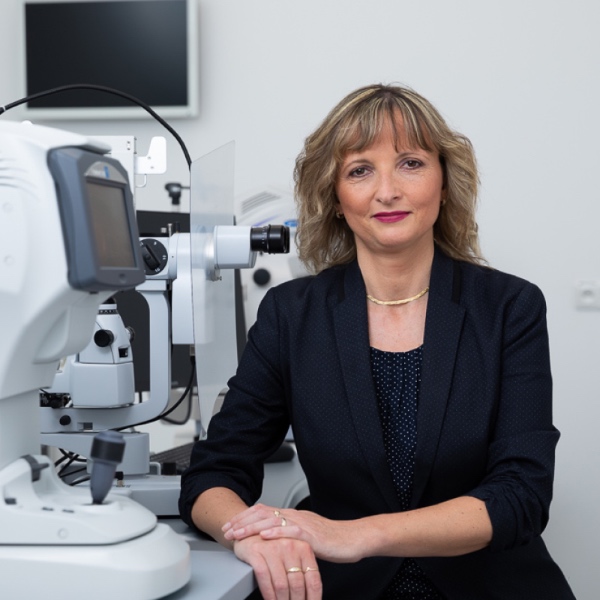
prof. MUDr. Petra Svozílková, Ph.D.

Professor Petra Svozílková, MD, PhD, is one of the Czech Republic's leading ophthalmologists, with almost 30 years of clinical experience. She works at the Department of Ophthalmology of the First Faculty of Medicine, Charles University and the General University Hospital in Prague, where she serves as Deputy Head of the Department and Head of the Centre for the Diagnosis and Treatment of Uveitis. In 2020, she was appointed Professor of Ophthalmology.


At MY CLINIC, Professor Svozílková combines the expertise of a leading university hospital with meticulous diagnostic assessment and a calm, patient-centred approach to eye care, ensuring that complex medical information is communicated clearly and understandably to every family.